Is Dubai tax free in 2026? The idea of a tax haven is what lures several foreigners and company owners to the Emirates. Nevertheless, the real world has changed into a more organized environment.
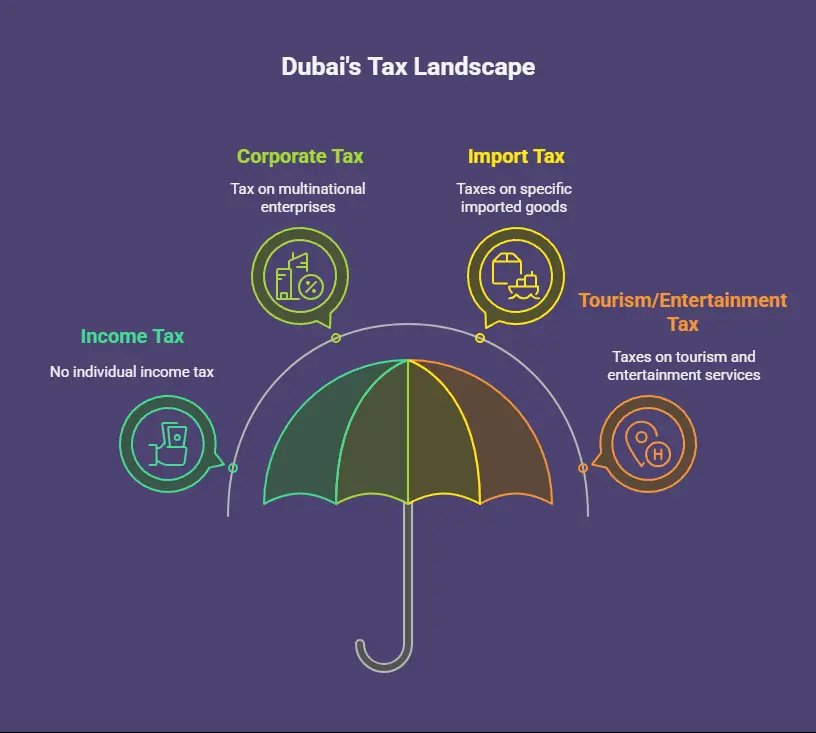
Dubai is still tax-free for individuals, but the city is no longer completely tax-free. Since the UAE is becoming more like other countries, residents now need to know about both business and consumption-based taxes in Dubai for expats.
This document looks at the present tax situation, including the 9 percent corporate tax, the five percent VAT, and the excise taxes on some commodities. We will also explain property taxes and what you need to do to be a UAE tax resident so that you may better manage your financial affairs this year.
What Does “Tax Free” Mean in Dubai—What It Doesn’t
Is Dubai really tax-free? Dubai is well-known for being a place where individuals may avoid paying taxes. However, the “zero-tax” term is not true for businesses or consumers. The UAE has combined multiple taxes to pay for outstanding facilities.
Business owners now have to pay a 9% corporation tax on profits over AED 375,000, and most products and services have a 5% VAT. Dubai has no income tax, so workers keep all of their earnings without paying federal taxes on earnings, capital gains, or inheritance.
Also, detrimental products like sugary beverages and tobacco are subject to excise taxes of fifty percent to 100 percent. Residents also need to pay municipality charges on their homes and four percent transfer fees when they buy or sell property.
Recent Tax Rates in Dubai 2026: Tax Updates You Must Know
The Dubai tax rates 2026 show that the economy is becoming more organized. Individuals still don’t need to pay taxes, but corporations and consumers must do so through several particular taxes to contribute to the country’s economy and infrastructure.
The UAE tax system explained indicates that corporation tax, VAT, and excise duties all work together. These measures keep the economy stable, and the metropolis is recognized as a very competitive global corporate center.
Tax on Personal Income
As mentioned, one of the best features of the UAE tax structure is that there is no personal income tax. In 2026, income tax in Dubai Confirm 0% for citizens or expats. This exemption covers salary, dividends, investment gains, and rental earnings from personal property. Residents don’t need to file tax returns with the Federal Tax Authority since they don’t owe any personal taxes.
The 9% Principle for Corporate Tax: What was Modified in 2023:
The flat 9% corporate tax in Dubai 2026 applies to taxable profits over AED 375,000. This framework has been in place since mid-2023 and affects all enterprises on the Mainland and some in Free Zones. To aid smaller enterprises, profits below AED 375,000 are exempted.
For instance, a consulting firm with a taxable profit of AED 500,000 only pays the UAE corporate tax rate 9%. Also, the Small Business Relief program lets enterprises that make less than AED 3 million a year be exempted from taxes on their income till December 2026.
Domestic Minimal 15% Top-Up Tax for International Companies:
The DMTT UAE 2025 rules are currently extremely significant for large corporations around the world. Under the global Pillar Two UAE framework, the rate of taxation applies to multinational firms with yearly revenues of €750 million or higher.
These large entities must ensure that their real tax rate is a minimum of 15% started in 2025. If the ordinary corporation tax and other incentives don’t add up to at least 15%, a top-up tax is added to cover the gap. It keeps the UAE in line with international requirements for preventing base erosion.
Are Free Zone Taxes Still 0%?
You can still stay in Dubai Free Zone tax-free, but it’s not an automated procedure. It needs to demonstrate “adequate substance” in the UAE, including having regular offices and staff.
It ensures that income comes from authorized activities, such as producing or providing services to headquarters.
A business must become a qualifying Free Zone person (QFZP) to keep its 0% tax rate. The normal tax rate of 9% applies to any unqualified revenue. It’s crucial to note that huge multinationals in Free Zones still need to pay the 15% DMTT, no matter what their zone status is.
What VAT 5% Covers in Dubai:
Most products and services still have a VAT Dubai rate 5% in Dubai. It has been a part of the local economy since it was first introduced in 2018. If an organization’s taxable turnover is more than AED 375,000 annually, it has to register for VAT.
Most retail and business transactions are subject to this 5% fee. However, several types of transportation, medical facilities, and fundamental education are generally exempt from taxes to make living costs reasonable for the public.
The Hidden Daily Tax: Excise Levy
The UAE excise tax 100% is a charge on detrimental goods for people’s health or the environment. It has a full tax on sugary drinks, tobacco, and a 15% charge on carbonated drinks. The thirty percent sales tax applied to alcohol was set back in place in January 2025 after being temporarily abolished.
At the time of purchase, customers have to pay a thirty percent levy to the municipality, and additional import duties if applied. It makes these products far more costly than other consumer goods.
Real Estate, Travel, and Additional Fees
There isn’t a typical Dubai property tax. However, owning property, purchasing property, and residing there all come with certain charges. Purchasers need to pay a Dubai 4% RERA transfer fee, while tenants have to pay a 5% municipal dwelling charge on top of their monthly utility costs.
Visitors need to pay a tourism tax of AED 7 or more each night. Most restaurants also add a service charge of ten percent to the bill. It is like an informal tourism tax at the conclusion of your meal.
Taxation for Dubai Freelancers and Self-Employed Expatriates
The Freelancer tax in Dubai is still quite appealing in 2026 since freelancers don’t need to pay any direct personal income tax on their earnings. They can keep all their revenue, whether they are a creative artist, a consultant, or a developer.
However, this tax-free status shifts when their business reaches certain financial goals. If their business makes more than AED one million a year, they need to register for corporation tax.
The Virtual Working Program is a unique option for self-employed Dubai tax obligations. With this remote work visa, individuals may reside in the city and work for clients or businesses outside the UAE.
This digital nomad Dubai taxes plan usually keeps the revenue out of the local corporation tax net. However, if they stay in the nation for more than 183 days, they may become a UAE tax resident. This status can support them to get a Tax Residency Certificate. So, they don’t need to pay taxes twice in their home country. But they need to monitor their worldwide tax footprint.
Be a Dubai Tax Resident—The 183-Day Rule for Taxation
To get Dubai tax residency in 2026, you need to meet certain physical presence requirements. Most of the time, genuine individuals can qualify by residing in the Emirates for at least 183 days in a year.
How long does one have to live in Dubai to be tax-free? You can fulfill the ninety-day criteria if you have a legitimate residence visa and stay or work in the nation full-time.
For enterprises, being legally tax-resident usually means being incorporated for a minimum of a year. Also, demonstrating that the business is well-managed and regulated in the UAE.
Getting a UAE tax residency certificate is the official means to show this status to authorities around the world. The Federal Tax Authority issues this document, valid for one year. To receive it, you need to provide your Emirates identification card, arrival and exit records, and a validated rental contract.
To get the benefits of the double taxation treaty, foreigners and firms must keep this status. It lets them avoid paying taxes on the same revenue twice. Also, lets them legitimately claim the tax-free privileges of residing in Dubai.
Residency Options Support Tax-Free Status in the Emirates
The UAE golden visa tax benefits are still a significant lure for long-term residents in 2026. They give a ten-year option to stability while maintaining personal income, capital gains, and wealth completely tax-free.
This self-funded alternative is great for significant worth investors and elite professionals who intend to set up a stable financial arrangement in the Emirates.
The UAE remote work visa for virtual assistants and remote workers also lets you reside and work in the nation with zero personal income taxes.
The employer-sponsored employment visa is for individuals looking for work and individuals who already have jobs. The five-year Green visa (self-sponsored) also benefits freelancers and skilled professionals by letting them keep all of their income while still supporting the local economy.
Is Dubai’s Tax-Free Status Applicable in Your Home Country?
Numerous foreigners want to avoid double taxation in Dubai, but the local tax-free rule does not apply around the world. There are more than 140 double taxation treaties in the UAE. The norms of your home nation still apply.
For example, US expat tax in Dubai is still necessary since the US taxes income from all over the world. The Foreign Earned Income Exclusion has been increased for the 2026 tax year. It helps numerous individuals lower their US tax bill.
The Statutory Residence Test decides the UK expat tax in the UAE. If you travel back to the UK within five years, you could pay “temporary non-residence” taxes on income you made while you were abroad. Always check your residency status to prevent getting trapped in tax traps you didn’t expect.
Major Incentives and R&D Tax Credit to Know in 2026
The UAE R&D tax credit 2026 will be a significant reason to come up with new ideas starting in 2026. This spending-based system gives a non-refundable credit of between thirty and fifty percent. It is for eligible R&D operations, up to a maximum of AED five million per year. It encourages helping enterprises in the country that are conducting new, methodical research.
The Qualifying High-Income Persons credit is another new UAE tax incentive. Federal Decree Law No. 17 of 2025 also makes significant changes, such as new reimbursement deadlines and new rules for voluntary disclosure. These changes make the audit process easier and ensure that the tax system remains open and competitive for multinational companies this year.
Seeking Assistance Navigating Dubai’s Tax Landscape?
Dubai will no longer be completely tax-free in 2026. But it will still be one of the most desirable locations in the world for individuals and companies due to its favorable tax regimes. It’s necessary to carefully deal with corporation tax, VAT, and residence requirements, especially for expatriates dealing with complicated cross-border tax duties.
Professional counsel ensures you stay in compliance while getting the most out of your finances. Get in touch with KPMPRO for expert assistance with tax registration or residency applications.
FAQs
Is there no tax at all in Dubai in 2026?
Dubai is not fully tax-free as it levies a nine percent corporate tax on high profits, 5 percent VAT on purchases, and various excise taxes on some commodities.
Do I need to pay taxes on my salary?
No, you don’t need to pay taxes on your salary. All citizens and workers in the UAE are still exempt from personal income tax.
How long do I have to reside in Dubai to receive a tax-free status?
Usually, you have to be resident in Dubai for 183 days per year. But you can also become a tax resident by residing in one place for 90 days in a row with permanent residence or work.
Do self-employed individuals and freelancers have to pay taxes in Dubai?
Freelancers don’t have to pay any personal tax, but individuals who make more than AED one million per year have to register for corporation tax and pay 9% on revenues over AED 375,000.
Do I still have to pay taxes in my home country if I relocate to Dubai?
It all relies on the legislation of your home country. US residents always file internationally, while UK and Indian citizens must pass certain conditions to avoid paying if they live abroad.
Are Dubai’s Free Zones still considered tax-free in 2026?
Free Zones only give zero percent tax to individuals who meet substantive requisites and income requirements. Higher taxes are charged on income that doesn’t qualify or on significant earnings from multinational companies.