
Is your business in UAE bringing in more than 7 figures in revenue? Then you have to correctly file and pay the corporate tax.
Introduced back in June 2023, corporate tax in UAE can still be confusing. You have to know if you are eligible to pay, how it applies to your business, which tier your business falls under, and how you can prevent incurring penalties.
We have a complete guide on this topic. It covers:
- What is corporate tax in UAE
- What Federal Tax Authority (FTA) expects from your business
- What are the newest updates to corporate taxes in 2026
- How much you might owe in these calculations
- How you can complete your corporate tax filing
- How KPM PRO assists you with our expertise
UAE Corporate Tax: What It Is & Why It Now Applies to You
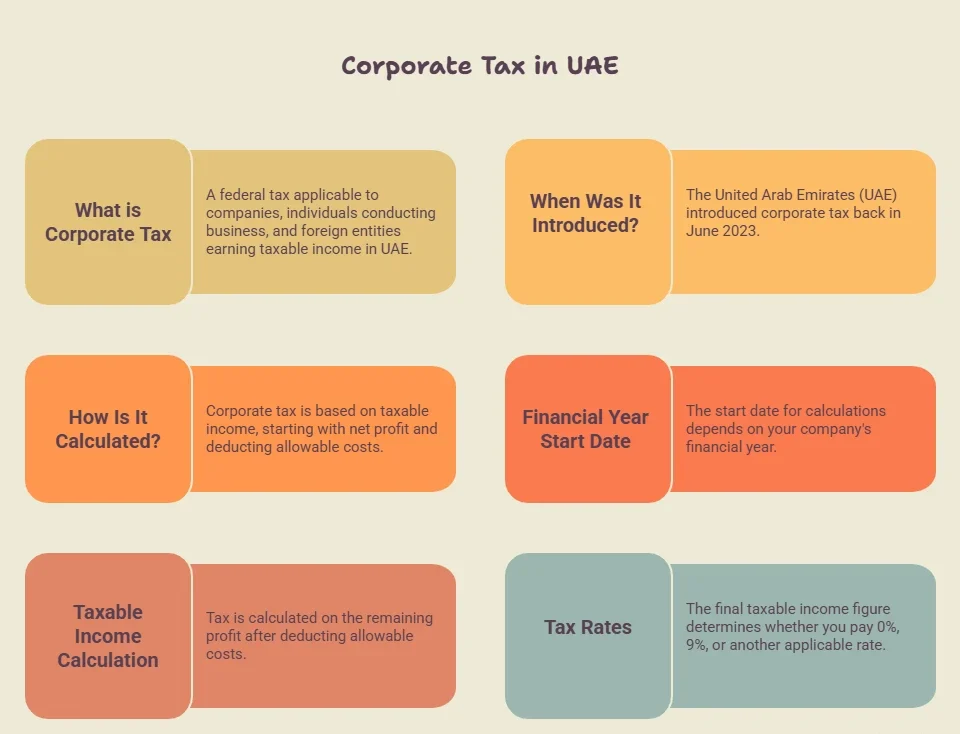
Corporate tax is a federal tax. If you are a company, an individual conducting business activities, or a foreign entity earning taxable income in UAE, then this tax applies to you.
When Did the UAE Introduce Corporate Tax?
The United Arab Emirates (UAE) introduced corporate tax back in June 2023.
How Corporate Tax Is Calculated in the UAE
Since the UAE introduced a corporate tax for financial years starting on or after 1 June 2023, the start date for calculations depends on your company’s financial year. Here’s how this works:
- If your financial year began on 1 January 2024, corporate tax is applied from that date.
- If your financial year began on 1 July 2023, your first corporate tax period started then.
As corporate tax is based on taxable income, you start with the net profit shown in your financial statements.
So, if your company generates AED 2 million in sales but spends AED 1.5 million on salaries, rent, operations, and other allowable costs, tax is calculated on the remaining profit.
The final taxable income figure determines whether you pay 0%, 9%, or another applicable rate.

The Tier Structure for UAE Corporate Tax Rates in 2026
There are tiers to the corporate tax. You either pay 0%, 9%, or 15% on the taxable profit.
0% Rate: Who Qualifies & Until When?
A business that has a taxable income of up to AED 375,000 benefits from a 0% corporate tax rate.
Eligible businesses that meet the required conditions can claim Small Business Relief UAE corporate tax provisions until 31 December 2026.
9% Rate: Standard Taxable Income Above AED 375,000
The standard tax rate in UAE becomes 9% once your taxable income exceeds AED 375,000.
15% Domestic Minimum Top-Up Tax for Large Multinationals
Large multinational groups operate under a different set of rules. The UAE’s domestic minimum top-up tax framework came into effect in January 2025 as part of the OECD Pillar Two initiative.
Does the DMTT Apply to Your Business?
The rules for Domestic Minimum Top-up Tax, or DMTT, only apply to multinational enterprise groups with annual consolidated revenue above EUR 750 million or more in at least 2 of the previous 4 financial years.
Who Pays Corporate Tax in UAE & Who Does Not?
Your business structure determines if you are eligible for paying corporate tax in UAE or are exempt from it.
Resident Companies and Mainland Businesses
Mainland LLCs, branches of UAE companies, and most commercial businesses operating within the UAE earning an income that exceeds AED 375,000 have to pay the standard 9% rate.
Free Zone Companies: The 0% Qualifying Income Rules
Free zone companies are not automatically exempt from corporate tax. A company can continue with a 0% rate on qualifying income if it meets the conditions required to become a Qualifying Free Zone Person (QFZP).
Income that does not qualify will still be taxed at 9%.
What Counts as Qualifying Income in a Free Zone?
To maintain QFZP (Qualifying Free Zone Person) status, a company needs to have adequate economic substance in the free zone, follow transfer pricing rules, and maintain audited financial statements.
Freelancers and Sole Proprietors: When You Are Liable
Under natural person corporate tax UAE rules, individuals conducting business activities become liable if their annual turnover exceeds AED 1 million during a calendar year.
Exempt Entities
Government entities, certain public benefit organizations, qualifying investment funds, and extractive businesses meeting specific conditions are exempt from UAE corporate tax.
Holding Companies and Participation Exemption
Holding company tax UAE provisions can exempt qualifying dividend income and capital gains from taxation.
Does Corporate Tax Apply to Foreign Investors?
UAE corporate tax for foreigners might apply if a foreign company has a permanent establishment in the UAE and earns taxable UAE-sourced income.
Simply owning shares in a UAE business does not automatically create a corporate tax obligation.
UAE Corporate Tax Amendments and 2026 Rule Changes
Several important UAE corporate tax amendments have taken effect or are being introduced during 2026.
Major changes and updates include the following:
- Expanded FTA audit powers under FDL 17/2025.
- New flat rate penalty rules under Cabinet Decision 129/2025.
- R&D tax credits ranging from 30% to 50%
- e-invoicing rollout for larger businesses beginning in July 2026
Corporate Tax Filing in UAE: Step by Step for 2026
If you’re wondering how to file corporate tax in UAE, the process follows three main stages.
Step 1: Register on EmaraTax
Registration takes place through the EmaraTax portal.
After approval, you receive a Corporate Tax Registration Number (CTRN).
New businesses have to register within three months of establishment.
Documents You Need Before You Register
You will need these documents before registering:
- Trade license
- Ownership details
- Registered address
- Authorization documents
- Financial information
Step 2: Confirm Your Tax Period and Deadline
The UAE corporate tax filing deadline follows the nine-month rule. If your financial year ends on 31 December 2025, your filing and payment deadline is 30 September 2026.
Step 3: Submit Your Corporate Tax Return
Your corporate tax return UAE submission is based on your financial statements, tax adjustments, and supporting documentation.
How to Pay Corporate Tax Through EmaraTax
Payment can be made through approved channels connected to the portal. The payment deadline is the same as the filing deadline.
What Happens If You Miss the Deadline?
A penalty of AED 500 per month during the first 12 months of delay is applied under the current rules. This penalty is then increased to AED 1,000 monthly afterward.
Corporate Tax Compliance: Staying Clean with the FTA in 2026
Here’s how you can stay compliant and transparent with the FTA:
Transfer Pricing Rules and Related Party Transactions
This is even more important for free zone businesses and corporate groups because qualifying income status heavily depends on their compliance integrity.
Record Keeping and Financial Statements
Your business should maintain its compliant financial records under IFRS standards and retain documentation for at least 7 years.
The FTA expects invoices, contracts, ledgers, transfer pricing records, and supporting evidence to be accessible upon request.
FTA Risk-Based Audit Triggers to Avoid
The FTA increasingly relies on automated profiling systems. Common UAE corporate tax FTA audit 2026 triggers include the following:
- Inconsistent tax filings, VAT, and corporate tax data
- Repeated unexplained losses without explanation
- Unusual refund claims
- Weak supporting documentation
Corporate Tax Services in UAE: When It’s Time to Bring in the Experts
Having experienced teams manage corporate taxes for you can save you from a lot of stress, hefty fines, and incurring penalties.
What a Corporate Tax Advisor in UAE Actually Does
A corporate tax consultant UAE assists you with handling registration, filing, tax planning, free zone structuring, transfer pricing reviews, and audit support.
Corporate Tax Advisory in Dubai: Questions Worth Asking
Before partnering with any corporate tax advisory in Dubai, you should ask them these questions to determine if they would be a good fit to work with your business:
- Have you handled businesses similar to mine?
- Do you have experience with free zone tax rules?
- How do you approach transfer pricing compliance?
- What support do you provide during an FTA audit?
- Have you handled free zone qualification reviews before?
- Do you have experience with transfer pricing documentation?
- Can you explain FTA audit exposure?
Make Filing Your Corporate Tax Easier with KPM PRO
Corporate tax in UAE is a major part of running a business. You need to know your taxable income, understand your filing deadline, keep accurate records, and register through EmaraTax on time.
If you are looking for experts with years of experience in managing and filing taxes for companies, get in touch with our team. At KPM PRO, we handle corporate taxes for you so you can continue running your business without stressing out every tax season. Contact us now.
FAQs
What is the corporate tax rate in UAE in 2026?
The UAE corporate tax rate is 0% on taxable income up to AED 375,000 and 9% above that threshold. Certain large multinational groups may face a 15% DMTT.
When did UAE corporate tax start?
Corporate tax in UAE became effective for financial years beginning on or after June 1, 2023.
Is there corporate tax in UAE free zones?
Free zone companies may still access a 0% rate on qualifying income if they meet QFZP conditions.
What is the deadline to file corporate tax in UAE?
Businesses must file and pay corporate tax within nine months after the end of their financial year.
Do freelancers pay corporate tax in UAE?
Freelancers and sole proprietors may become liable if annual business turnover exceeds AED 1 million.
What changed in UAE corporate tax rules in 2026?
Changes in UAE corporate tax rules in 2026 include revised penalty rules, expanded FTA audit powers, R&D tax credits, and e invoicing implementation steps.
What are the penalties for late corporate tax filing in UAE?
Penalties for late corporate tax filing in UAE start at AED 500 per month for the first year. Afterward the penalties increase to AED 1000 monthly.
How do I register for corporate tax in UAE?
You can register for corporate tax in the UAE through the EmaraTax platform using your company licensing and ownership documents.
Does corporate tax apply to foreign companies in UAE?
Corporate tax applies to foreign companies in UAE if they have a permanent establishment in UAE or earn taxable UAE-sourced income.
What is Small Business Relief in UAE corporate tax?
Small Business Relief allows eligible businesses meeting revenue conditions to claim temporary tax relief through December 2026.