Dubai is not slowing down. The city keeps moving with each passing time. The emirate’s trade volume crossed 612 billion dirhams in Q1 2025 alone. This shows a 7.2 percent year-on-year increase driven by electronics, machinery, logistics, and re-export activity. Asia, Europe, and Africa businesses continue using Dubai as their gateway to global trade. There’s one important detail that many first-time entrepreneurs discover too late. But you shouldn’t! Getting the wrong business license can lock you into unnecessary costs, limited activities, and expensive amendments later.
Because of this, the General Trading License has become the most searched business setup option in the UAE. The license gives your business flexibility to trade multiple product categories under one company structure. Yet the landscape changed amicably after 2023. Corporate tax is now mandatory. VAT compliance matters from day one. Mainland and free zone setups differ more than most setup agencies admit.
We’ll break down in this guide:
- The real 2026 costs
- Compliance obligations
- Set up the process, and
- Strategic decisions behind a Trading License
Know everything right before you spend your first dirham!
What’s a General Trading License in Dubai?
A General Trading License is a commercial permit. It is issued by Dubai’s (DET) Department of Economy and Tourism or a UAE free zone authority. Under a single license, your company can import, export, distribute, store, and sell multiple unrelated product categories.
Quite different from a standard commercial license, which limits you to one or two product categories. Whereas a General Trading License Dubai setup gives broader flexibility across industries.
| Entity Structure | Included Trading Categories |
| Single Company / Same Legal Entity | Electronics, Clothing, Furniture, Packaging Materials, Home Appliances, Industrial Supplies |
That flexibility has its significance. Because Dubai’s trading market changes fast. One quarter, consumer electronics are booming. Next, packaging supplies surge because of e-commerce demand. A General Trading License permits businesses to pivot immediately without regularly amending their license.
However, there is an important limit that many new investors misunderstand: General doesn’t mean unrestricted. A General Trading License still has a maximum of ten listed activities. To sell restricted goods, you may require additional approvals regardless of license type.
What Can You Trade Under a General Trading License?
Many entrepreneurs search: “What can I trade with a general trading license in the UAE?” We’ll give you the practical answer below in the form of a product list that you can trade.
Permitted products:
These are the common categories that you can easily trade under your license:
- Electronics
- Clothing and apparel
- Furniture
- Food products
- Textiles
- Toys
- Packaging materials
- Home appliances
- Industrial supplies
- Cosmetics
Restricted or separately regulated goods:
The items that require special approvals or separate licenses are Alcohol, Pharmaceuticals, Medical devices, Tobacco products, Precious metals, Vehicles, Weapons, and Hazardous chemicals.
This distinction is essential because many business owners assume a General Trading License automatically covers everything. But in reality, it doesn’t.
Taking a few examples to understand it better.
- Selling cosmetics may require municipal approvals.
- Trading gold may require DMCC-specific permissions.
- Medical devices require health authority clearances.
Don’t ignore this at any cost. If you ignore it, you’re making the most expensive mistakes that new importers make.
General Trading License vs. Commercial License: Which One Do You Need?
Many setup consultants oversell here. A General Trading License in the UAE setup sounds attractive because it offers flexibility. But smart owners like you should know that flexibility comes at a cost.
A General Trading License costs you around 3,000 to 8,000 dirhams more annually than a standard commercial license.
So when does it make sense? Let’s find out when you need a general license and when not.
| Business Type | Best Option |
| 2–3 stable product categories | Standard Commercial License |
| Frequently changing products | General Trading License |
| Wholesale/import-export business | General Trading License |
| Multi-category e-commerce | General Trading License |
| Single niche retail store | Commercial License |
Simple decision rule:
Select a standard commercial license if you have two or three fixed categories. A General Trading License is a suitable option if four or more categories are involved or if inventory is changing regularly.
A growing business? The ability to add products without repeated amendments saves money long term. It means go for a general trade license that suits you best.
General Trading License Cost in Dubai:
The huge misconception circulating online is that there’s a single fixed cost. In reality, this is not the case. Your General Trading License cost depends on many factors. The mainland vs free zone, visa requirements, office size, number of shareholders, business activities, and customs registrations decide the actual price.
Mainland Setup Cost: DET Dubai
A mainland General Trading License provides unrestricted UAE market access.
Typical Year 1 costs:
| Expense | Estimated Cost in Dirhams |
| Base government license fee | 12,000–15,000 |
| Office/Ejari registration | Variable |
| Chamber membership | 1,200–3,000 |
| MOA notarization + PRO fees | 2,000–5,000 |
| Visa cost per person | 3,000–4,000 |
Estimated Year 1 Total:
It usually falls between 30,000 and 50,000+ dirhams. The largest variable is office rent. Even though Dubai now allows hundred percent foreign ownership for most trading activities. Still, mainland companies require a physical Ejari-registered office.
Free Zone Setup Cost:
Free zones remain popular because entry costs are lower.
Entry-level free zones:
The popular free zones of Dubai are IFZA, Shams, RAKEZ, and Ajman Free Zone. The package ranges from 11,900 to 18,000 dirhams. The cost includes expenses related to the license, shared desk/flexi desk, and one visa allocation.
Premium free zones:
| Free Zone | Typical Cost in Dirhams |
| DMCC | 20,000–35,000+ |
| JAFZA | 25,000+ |
Major advantage:
You avoid expensive office leases through flexi-desk setups.
Major limitation:
Besides the advantage, you can’t directly sell into the UAE mainland market without a mainland distributor or a mainland branch/company. This distinction becomes necessary for businesses to consider targeting local UAE consumers.
Year 2 Renewal Cost:
Your license must be renewed on a yearly basis. Renewal costs are 60 to 70 percent of the Year 1 setup costs. The cost is lower than what you spent in the first year. Because one-time setup expenses disappear. However, Ejari must remain valid, Chamber membership renewals apply, and visa renewals continue. Renewing you licese late can invite sudden penalties and freeze operations. No employer wants to experience this. That’s why you should take renewals seriously. Be wise to renew at least thirty days before expiry.

Requirements for a General Trading License in Dubai
The General Trading License requirements are simple to follow but document-heavy.
Required documents
- Passport copies of shareholders/directors
- Emirates ID for UAE residents
- No Objection Certificate, if employed in the UAE
- Trade name reservation
- Initial approval certificate
- Notarized MOA for LLCs
- Ejari tenancy contract for the mainland
Capital requirement:
For LLC structures, many authorities require a declared capital of 300,000 dirhams. This amount must appear in the MOA. A physical bank guarantee is not always required.
Process to Get a General Trading License in Dubai:
Talking about 2026, the setup process becomes faster than ever before. Some free zones now issue licenses within hours.
Mainland (DET) Process:
Step 1 —> Reserve trade name
Apply via DET portal or DED Now app. The timeline is 1 to 3 business days.
Step 2 —> Obtain initial approval
This confirms DET accepts the proposed activity.
Step 3 —> Prepare MOA
Required for LLC structures.
Step 4 —> Lease office and register Ejari
Ejari registration costs approximately AED 160.
Step 5 —> Chamber membership
Mandatory for most mainland traders.
Step 6 —> Pay government fees
License issuance often happens within 1–3 business days.
Step 7 —> Customs registration
Required before importing goods.
Step 8 —> Open a bank account
This step can take longer than licensing itself. Banks now apply stricter compliance checks after the UAE AML reforms.
Step 9 —> Apply for visas
Investor and employee visas follow afterward.
Free Zone Process
The process is broadly similar but more streamlined. Many free zones now operate fully digitally. A few key differences are found between the processes for mainland and free zones, such as:
- No Ejari requirement
- Shared workspace accepted
- No local sponsor needed
- Faster approvals
Some zones issue licenses in under sixty minutes when documentation is complete.
Mainland vs. Free Zone: Which Is Right for Your General Trading Business?
Between the two, which will be the right fit for your business? This question is the most important strategic decision!
Mainland Setup:
Best for:
The mainland business set-up is quite suitable for UAE-focused businesses. If you have retail operations, you can prefer a mainland business setup. Mainland is also a good choice if your business directly sells to UAE customers.
Advantages:
Doing business in the mainland gives you full UAE market access. You have no restriction on local sales. The mainland business has unlimited growth potential. Your visa allocation is linked to office size. Under a mainland setup, full foreign ownership is allowed for most activities.
Limitation
Besides many advantages, the mainland setup has a higher operational cost. A physical office is mandatory to operate your business.
Free Zone Setup:
Best for:
Setting up your business in a free zone makes sense if you have a re-export business. Free zones are a better choice for international trading and e-commerce startups. If you want a lower-cost entry setup, free zones work well.
Advantages:
Free zone business setups have a lower startup cost. You can set up your business there very fast. The business owners can enjoy tax incentives only for qualifying income. You no more require to pay customs duty inside free zones.
Limitation:
No direct mainland trading is recommended without intermediaries.
Best free zones by industry:
From industry to industry, free zones vary.
| Industry | Recommended Free Zone |
| Commodities/metals | DMCC |
| Logistics/import-export | JAFZA |
| E-commerce startups | IFZA |
| Budget startup setups | RAKEZ |
Simple recommendation:
- UAE local customers → Mainland
- International trade/re-export → Free Zone
Tax & Compliance Obligations After Getting Your General Trading License:
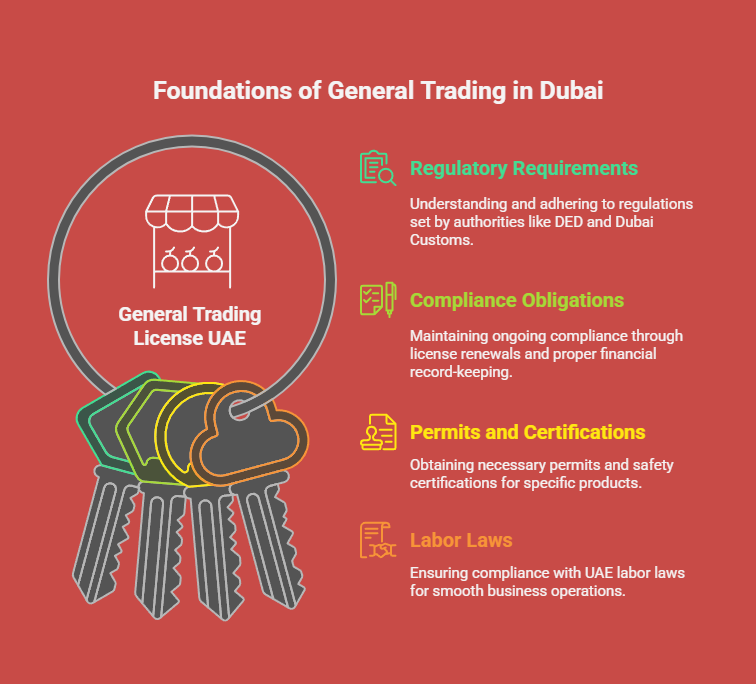
Compliance and tax obligations are where many businesses get blindsided. Licensing is only the beginning. The real struggle starts afterwards.
Corporate Tax:
The UAE introduced federal corporate tax for financial years beginning after June 1, 2023.
Current rates:
| Taxable Profit | Tax Rate in Percent |
| Up to 375,000 Dirhams | 0 |
| Above 375,000 Dirhams | 9 |
All General Trading License holders must register with the Federal Tax Authority. The FTA includes mainland companies, free zone companies, small businesses, and dormant entities.
Important 2026 reality:
Late registration penalties remain serious; don’t take it lightly. The standard fine is 10,000 dirhams. Corporate tax returns are generally due within nine months after the financial year-end.
Still, free zone businesses may qualify for zero percent tax on qualifying income. Only if they meet compliance conditions.
VAT
VAT registration becomes mandatory once taxable supplies exceed:
AED 375,000 annually
Voluntary registration begins at:
AED 187,500
For trading businesses, VAT registration often makes financial sense early because import VAT can be reclaimed.
Key VAT rules
- Import VAT: 5%
- Exports outside the UAE: usually zero-rated
- Input VAT recovery available for registered businesses
Customs Registration
A license alone does not authorize imports.
Before your first shipment, you must register with Dubai Customs and obtain a customs code.
Every shipment requires:
- Commercial invoices
- Packing lists
- HS codes
- Certificates of origin
Poor customs documentation is one of the fastest ways to delay shipments at UAE ports.
How long does it take to get a Dubai General Trading License?
The duration to get your licenses takes one day to one week. It depends on the region and the documentation.
Dubai enjoys the tag of an attractive trading hub globally. Don’t think that success is easy here. Once you reach the Dubai market, your business story takes another turn. The right setup decisions early will save you from the mistakes that most business owners make. Start by determining whether a General Trading License is necessary or a standard commercial license fits your product range better. Second, select the mainland or free zone. The decision is based on where your customers are located. Third, build corporate tax and VAT compliance into your business from day one. Not after the penalties arrive.
Planning a Dubai trading business? Now is the right time to speak with a qualified setup and tax advisor before filing your application. KPM PRO is here to assist. Get everything settled in days by obtaining the expert’s help.
FAQs
How much does a General Trading License cost in Dubai?
The cost ranges from 30,000 to 50,000+ dirhams for mainland setups. Similarly, 11,900 to 35,000+ dirhams are charged in free zones. The visas and office requirements disclose the actual price.
Can a foreigner fully own a Trading License company in Dubai?
Most trading activities now allow full foreign ownership under UAE commercial law reforms.
What goods are prohibited under a Trading License?
These are prohibited categories:
- Alcohol
- Pharmaceuticals
- Tobacco
- Weapons
- Chemicals, and
- Medical products
They all require separate approvals.
Do I need to pay corporate tax with a Trading License in the UAE?
Corporate tax registration is mandatory for both mainland and free zone entities.
What’s the difference between a General Trading License and a Trading License?
General Trading License:
It allows multiple unrelated products to sell.
Standard trading license:
It restricts activities to specific categories.
Can I use a General Trading License for e-commerce in Dubai?
Many e-commerce import/export businesses use General Trading Licenses. It mostly happened in free zones.