
Are you an aspiring entrepreneur, online seller, or a foreign investor in UAE’s ecommerce sector? As its e-commerce market surpasses AED 40 billion, UAE is becoming one of the fastest growing digital economies. All you need is to choose the right license type, know what the setup costs, and stay compliant even after launch.
If you are selling through a website, social media, or online marketplace, you should know the available license types, costs, registration process, and legal requirements you need to understand in 2026. And that’s exactly what this guide covers.
What is an E-Commerce License in the UAE?
An e-commerce license is a legal permit which allows you as an individual or a business to sell your products or services online within UAE and internationally. Your license authorizes the activities you conduct through websites, mobile applications, social media platforms, and online marketplaces.
UAE requires businesses operating online to hold a valid license regardless of size. Even if you only sell products through Instagram, Facebook, TikTok, or WhatsApp, you are considered to be conducting commercial activities and must obtain the appropriate authorization.
Operating without a UAE online business license can lead to fines, business restrictions, payment gateway issues, and difficulties opening corporate bank accounts.
Who Needs One?
Everyone on this list is required to hold a valid e-commerce license which Dubai authorities or free zones recognize:
- Foreign investors setting up a company
- International entrepreneurs launching online stores, SaaS businesses, or digital product companies
- UAE residents selling online
- Residents creating online retail brands or home-based businesses require a formal license before accepting payments
- Freelancers using social media
- Individuals selling handmade goods, consulting services, beauty products, or digital content through social media channels still need legal authorization
- Marketplace sellers
- Businesses selling through Amazon, Noon, or other third-party platforms
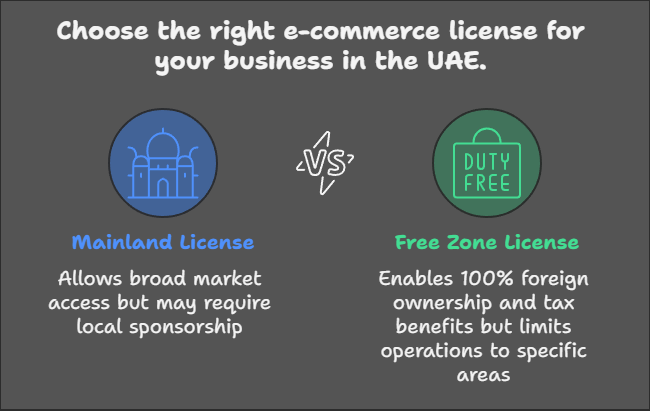
4 Types of E-Commerce Licenses in the UAE (And Which One Fits You)
Knowing the different types of e-commerce licenses UAE can help you determine which one suits your business activities.
E-Trader License
The E-Trader License is for UAE residents and GCC nationals who operate small-scale businesses through social media. It is issued as a sole proprietorship and works well for influencers, home businesses, and individuals testing a business concept before scaling. The annual cost for this license ranges between AED 1,070 and AED 1,370.
However, there are limitations. E-Trader holders cannot operate a dedicated website, hire employees, or open a full corporate bank account.
Mainland E-Commerce License
A mainland e-commerce license is issued through the relevant Department of Economic Development (DED) or equivalent authority in each emirate.
This option suits businesses that have UAE consumers, government contracts, local distribution networks, and companies requiring unrestricted access to the domestic market.
Mainland businesses can sell throughout the UAE without requiring intermediaries or distributors.
Applicants require approval from the Telecommunications and Digital Government Regulatory Authority (TDRA) for online commercial activities.
Setup costs start between AED 12,000 and AED 25,000 and can increase depending on office requirements and visa allocations.
Free Zone E-Commerce License
A free zone e-commerce license remains one of the most popular choices for foreign investors because it offers 100% foreign ownership, streamlined registration, and competitive setup packages.
While free zone companies can trade internationally with ease, direct sales to UAE mainland customers require a local distributor or additional licensing structure.
Costs range from AED 5,750 to AED 20,000 or more depending on the selected jurisdiction and visa package.
Popular free zones include:
SHAMS
Suitable for startups, digital businesses, and entrepreneurs seeking affordable entry costs.
IFZA
Popular among international investors looking for flexible business activities and visa options.
RAKEZ
Offers cost-effective packages for e-commerce startups and growing SMEs.
Dubai CommerCity
Purpose-built for e-commerce businesses requiring logistics, warehousing, and fulfillment support.
Meydan Free Zone
Known for fast incorporation processes and strong support for digital-first businesses.
Portal or E-Marketplace License
This license category is for businesses operating a platform that connects buyers and sellers.
Unlike a traditional online store, the business does not necessarily sell its own products. Instead, it facilitates transactions between third parties.
Examples include marketplace websites, service aggregation platforms, and multi-vendor portals.
Marketplace operators often require separate licensing approvals.
How Much Does an E-Commerce License in the UAE Cost?
This is what an e-commerce license costs you in UAE:
- E-Trader License available only to UAE residents and GCC nationals: AED 1,070 to AED 1,370 annually
- Free Zone License Only (No Visa): AED 5,750 to AED 12,900 depending on the selected free zone
- Free Zone Package (License + One Visa + Flexi Desk): AED 13,000 to AED 20,000+
- Mainland E-Commerce License: AED 12,000 to AED 25,000+ excluding office expenses
- Estimated Total First-Year Budget: Approximately AED 13,000 on the low end to AED 60,000+ for mainland companies requiring office space and visas
How You Can Get Your E-Commerce License in the UAE in 7 Simple Steps
You can get your own e-commerce license in the UAE by following this step-by-step process:
Step 1: Choose Your Business Activity and License Type
You need to identify how exactly your business will be generating its revenue i.e. the type of service or products you will be selling and on which online platform. Your business activities determine if you need an e-trader license, a mainland one, a free zone license, or a marketplace license.
Step 2: Select Your Jurisdiction
Next step is choosing your jurisdiction. You have to decide between mainland and free zone registration.
Mainland registration is for when your primary customers are UAE residents.
If you are offering digital services or focusing on international sales, you will get a greater amount of flexibility and lower setup costs with a free zone license.
Step 3: Register Your Trade Name
After you have selected the jurisdiction, it’s time to have your trade name registered.
Submit your preferred company name to the relevant licensing authority. The name you choose should comply with UAE naming regulations and not violate any trademark, religious, or public decency rules.
Step 4: Get Initial Approval and TDRA Clearance
Your application is then reviewed by authorities who then issue you initial approval.
For carrying out online business activities, mainland applications are required to have clearance from TDRA (Telecommunications and Digital Government Regulatory Authority).
Step 5: Submit Documents and Pay Fees
You will have to submit your passport copies, proof of residence, Emirates ID, and business plan. You need to pay the licensing fees after you get the approval.
Step 6: Receive License and Open a Business Bank Account
Receiving business income through a personal bank account should be avoided as it creates compliance and taxation risks. That’s why you should open your corporate bank account right away once your license is issued.
Step 7: Apply for Residence Visa
As an e-commerce license holder, you can qualify your UAE residence visa valid for up to 2 years. Moreover, eligible business owners can also sponsor their family members.
Legal Compliance After You Get Your License
Even after you have gotten your license, there are certain rules you need to follow to remain legally compliant and continue to run your business operations in the UAE.
Federal Decree-Law No. 14 of 2023: What It Means for You
Federal Decree-Law No. 14 of 2023 governs online commercial activities conducted through websites, mobile applications, marketplaces, and social media channels.
This law emphasizes cybersecurity standards, transparent pricing, consumer rights, secure payment systems, and coordination with authorities including the TDRA, Federal Tax Authority (FTA), and Central Bank.
As a business, you have to make sure your digital operations meet these standards from the start.
VAT Registration
The standard VAT rate remains 5% on applicable UAE sales, while qualifying exports outside the UAE are zero-rated.
- Once your taxable turnover exceeds AED 375,000, VAT registration applies to you.
- If you are a business generating at least AED 187,500, you can apply for voluntary registration.
Corporate Tax
Many free zone businesses qualify for a 0% corporate tax rate on their qualifying income. They still have to register, maintain records, and file annual tax returns.
Income generated from mainland activities can be subject to the standard 9% corporate tax rate.
Consumer Protection and Data Privacy
E-commerce businesses are required to comply with Consumer Protection Law No. 15 of 2020 and applicable e-commerce regulations.
Website terms and conditions should be available in Arabic or bilingual formats where required.
Businesses collecting customer information also have to comply with Federal Decree-Law No. 45 of 2021 concerning Personal Data Protection.
Not protecting customer data can incur regulatory penalties and reputational damage for your business.
Your Quick Decision Guide for Mainland vs Free Zone
You should choose:
- Mainland if you want to sell directly to UAE consumers without restrictions
- Free Zone if you are a foreign investor who wants full ownership, lower setup costs, and international reach
- E-Trader if you are a UAE resident selling primarily through social media
- Dubai CommerCity if logistics, fulfillment, warehousing, and large-scale e-commerce operations are central to your strategy
- SHAMS, IFZA, or RAKEZ if affordability and digital-first operations are your main priorities
Apply for Your E-commerce License Today with KPMPRO
You need to identify which license type best matches your activities, select the jurisdiction that supports it, and know how you can remain compliant from the start.
Your business model, customer location, and ownership – all have an impact on which is the best e-commerce license in the UAE for your business. If you are considering which structure suits your commercial activities the most, book a free consultation with us.
At KPMPRO, we manage licensing, taxation, and regulatory requirements for you. Apply for your e-commerce license today with us.
Frequently Asked Questions
Can I sell on Instagram in the UAE without a license?
You cannot sell on instagram in the UAE without a license because selling on any social media platform is considered a commercial activity in the emirates and requires you to have a valid license.
How long does it take to get an e-commerce license in the UAE?
It can take anywhere between a few days and several weeks for you to get your e-commerce license in the UAE.
Do I need a physical office for an e-commerce license in the UAE?
You do not always need a physical office for an e-commerce license in the UAE. Many free zones offer flexi-desk packages that meet office requirements so you don’t have to lease dedicated premises.
Can a foreigner get an e-commerce license in the UAE without a UAE visa?
Several free zones allow foreign investors to establish companies without a UAE residence visa.
What is the cheapest e-commerce license in the UAE?
The e-Trader License is the most affordable option among e-commerce licenses in UAE.
Does a free zone e-commerce license allow selling to UAE customers?
A free zone e-commerce license allows selling to UAE customers. Your business still might need a local distributor, logistics partner, or additional licensing structure, depending on your business activities.
Is VAT applicable to e-commerce businesses in the UAE?
VAT is applicable to e-commerce businesses in UAE if the business exceeds the mandatory threshold and its sales qualify to be taxable.